Slapping a chatbot on a to-do list does not make it intelligent. The test of an AI task manager is simple: does it remove the work that made your last task manager fail?
Why task managers fail (and where AI actually helps)
Traditional task apps fail at two moments: the filing moment, where every captured task demands a project, priority, and date; and the choosing moment, where a groomed list still cannot tell you what to do with the twenty minutes you have. Both failures are administrative, which is precisely the labor worth automating. AI that writes your tasks in nicer sentences solves neither; AI that eliminates filing and choosing solves both.
The three jobs that matter
- Structuring the mess. Human capture is messy by nature: run-on voice notes, five tasks in a sentence, a worry stapled to an errand. The AI's first job is turning that into discrete, checkable tasks clustered into projects, with zero questions asked. In Sukima this is just what capture does.
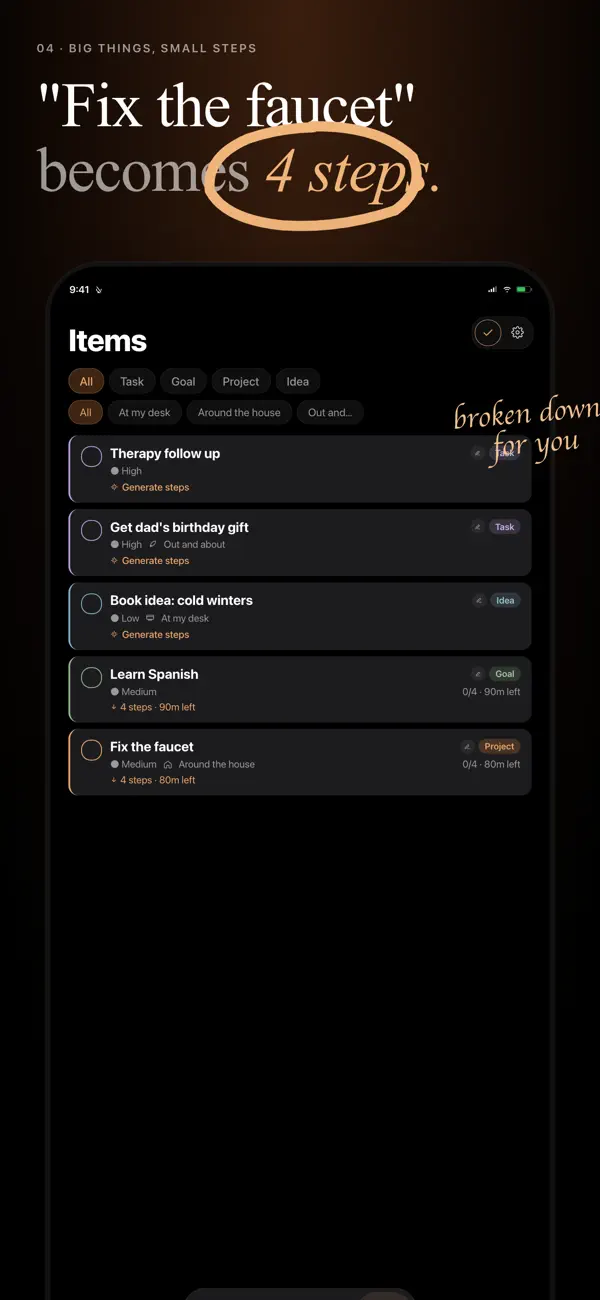
- Understanding the tasks. "Email Mark" is ten minutes; "redo the deck" is two hours and a quiet room. An AI that grasps rough size and context can match work to real moments instead of treating every task as an identical checkbox.
- Making the pick. The highest-value decision in personal productivity is "what now?", made dozens of times daily, usually badly, always expensively. Sukima answers it with one task sized to the gap you are in, which is the feature the whole system exists to serve.
What the AI should never take
Deciding what matters in your life is not administrative labor, and an app has no business doing it. Sukima never invents commitments, never reshuffles your priorities behind your back, and never guilt-trips. You choose what enters the system and what a good week looks like; the AI handles the clerical middle: sorting, sizing, sequencing, picking. Empathetic by design, and calm on purpose: no streaks, no shame mechanics, no red badges shouting at you.
- Speak five tasks in one rambling sentence. Does it produce five organized tasks?
- Tell it you have fifteen minutes. Does it hand you one right-sized thing?
- Ask for a day plan. Is it honest about your actual free time?
- Sukima is built to pass all three; that is the whole pitch.
Where this is headed
The task manager category spent twenty years adding fields and views, pushing the clerical work onto you with prettier chrome. The AI turn reverses the direction: the system absorbs the clerical work, and the interface shrinks toward a single honest question and a single good answer. What now? This. That is the entire future of the category, and you can use it today.
Frequently asked questions
Keep reading
Your day is full of gaps. Sukima fills them.
Brain dump everything on your mind and get told exactly what to do next. No setup, no sorting, no decisions required.
Download on the App Store Get it on Google Play Open the web app →