It's Sunday evening and you can't relax.
Not because anything bad has happened. Not because there's an active emergency. Just because somewhere in the back of your mind, a list is running. The email you haven't sent. The call you keep putting off. The thing from last week you told yourself you'd sort out this week. The seventeen small things that have accumulated without resolution.
You try to watch something. Read something. The list keeps surfacing.
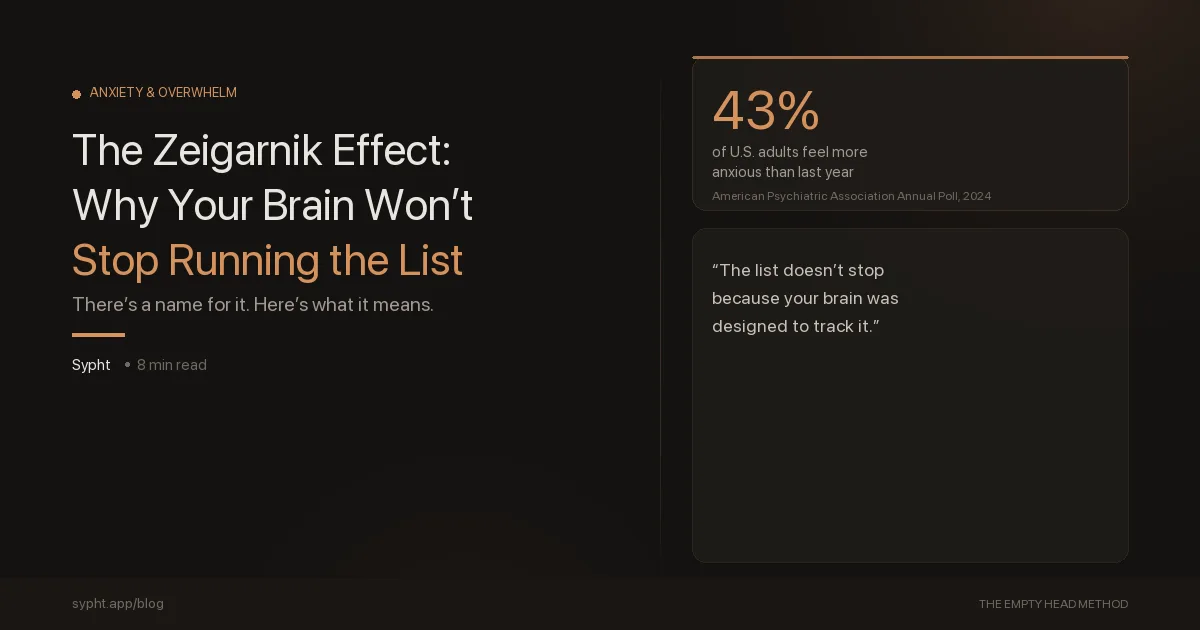
This isn't anxiety in the clinical sense, necessarily. It's something more specific, and it has a name: the Zeigarnik Effect. Understanding it helps explain why it happens, why it's so difficult to override, and, crucially, what actually stops it.
Where does the Zeigarnik effect come from?
In the 1920s, psychology researcher Bluma Zeigarnik made an observation in a Vienna café that would shape cognitive psychology for the next century. Waiters, she noticed, had remarkable recall for the details of unpaid orders, which tables had ordered what, who needed refills, what was still outstanding. But the moment the bill was paid, the information evaporated. Completed orders left no cognitive trace.
Zeigarnik turned this observation into a formal research program. She found that unfinished or interrupted tasks were significantly better remembered than completed ones, in her initial experiments, participants recalled incomplete tasks nearly twice as often as completed tasks. She concluded that starting a task creates a state of psychological tension that keeps it mentally active until completion. Completion releases the tension. Incompletion doesn't.
This tension isn't a weakness or a flaw in the system. It evolved for good reasons. For our ancestors, an unfinished task, an unbuilt shelter, an unfollowed trail, could be fatal if forgotten. The brain's drive to keep unresolved things cognitively active is a survival mechanism.
The problem is that in modern life, the number of unresolved things can be enormous, and the mechanism that was designed to track one or two critical tasks is now trying to hold forty.
Open Loops and Cognitive Load
When psychologists and productivity researchers talk about "open loops," they mean exactly what the Zeigarnik Effect describes: tasks and obligations that have been started, noted, or committed to but not resolved.
Each open loop occupies a small but real portion of working memory. It requires ongoing cognitive resources to maintain, the brain keeps the loop active, surfaces it periodically, and invests attention in monitoring it. One or two open loops are manageable. Twenty or thirty create a constant background cognitive hum that makes sustained focus difficult, genuine rest feel impossible, and sleep quality noticeably worse.
Research by Weigelt and Syrek (2017), published in the Journal of Occupational Health Psychology, tracked employees over 12 weeks and found that unfinished tasks at the end of the workweek significantly impaired weekend recovery through rumination. The mechanism was clear: unresolved work maintained elevated psychological activation during what should have been rest time. The more tasks left open, the greater the impairment.
This is the mechanism behind the Sunday evening feeling. Your brain is not malfunctioning. It is doing exactly what it's designed to do, tracking open loops, surfacing them for attention, preventing you from forgetting them. The problem is scale: modern life generates far more open loops than the system was built to manage.
Why doesn't "just relax" work?
When someone experiencing Zeigarnik-driven rumination is told to "just stop thinking about it" or "leave work at work," the advice fails at a mechanistic level.
The active maintenance of open loops isn't a choice. It's an automatic background process. You can consciously redirect your attention, focus on the film, the conversation, the book, but the loops keep running. They don't require your active attention to persist. They persist because they're incomplete, not because you're thinking about them.
This is why anxiety-management techniques that focus on attention redirection (distraction, mindfulness of other things) provide only temporary relief for this specific type of rumination. They redirect the foreground. The background keeps running.
What actually closes open loops is what Zeigarnik's research, and later work by Masicampo and Baumeister, points toward: resolution, or the credible representation of resolution. Masicampo and Baumeister (2011) found that simply making a specific plan for an unfulfilled goal eliminated the cognitive interference caused by it. The brain didn't need the task to be done. It needed to know the task was held somewhere reliable with a clear next step.
Writing things down works for the same reason. Getting a thought into a trusted external system tells the brain: "this is held, you don't need to keep tracking it." The loop closes, not because it's complete, but because the brain is satisfied that it won't be forgotten.
The Scale Problem
Here's the challenge: for people with high anxiety or overwhelm, the number of open loops is often too large for ad hoc management.
You can write down three things. You can write down ten things. But if you have forty open loops, tasks, worries, half-formed intentions, things you've been meaning to look into, and you know you have forty, the act of writing down ten doesn't fully close the remaining thirty. The brain is not satisfied by partial externalisation. It knows the rest are still in there.
A genuinely effective thought capture, getting everything out, not the things that seem important enough to capture, is different in character from a to-do list. A to-do list is a curated record of explicit tasks. A thought capture is an attempt to fully empty working memory of every active loop, however small or vague.
The difference matters because it's the completeness that closes the loops. Partial capture is better than nothing, but the relief that follows a complete thought capture is qualitatively different, the hum goes quiet in a way that partial capture doesn't achieve.
How do you close open loops before sleep?
The Zeigarnik Effect has a particularly significant impact on sleep. The period before sleep, the quieting of external stimulation, removes the competing inputs that suppressed the loops during the day. In silence, they surface.
This is experienced as "my mind races when I try to sleep," and it's a near-universal complaint among people dealing with high volumes of unresolved tasks or anxiety.
Research supports what many people discover experientially: a brief thought capture before bed, getting every outstanding thought, task, or worry externalised into something reliable, measurably improves the ability to fall asleep. Not because the tasks are done, but because the brain has been told they're held.
Five minutes of offloading before sleep, for many people, is more effective than any other pre-sleep routine. It directly addresses the mechanism causing the problem rather than trying to redirect attention away from it.
The Bigger Picture
The Zeigarnik Effect isn't a pathology. It's the same mechanism that makes humans reliable goal-pursuers, keeps commitments active in mind, and drives follow-through on intentions. Managed well, it's a useful feature.
The modern problem is volume. Human cognitive architecture evolved in environments with a handful of critical open loops at any time. Contemporary life can generate dozens in a day, work tasks, personal obligations, digital communications, ongoing projects, things we've read and meant to act on.
The solution isn't to become better at holding more. It's to stop holding so much, by getting it out of your head and into a system you trust, completely, regularly, and quickly enough that the capture itself doesn't become a burden.
Your brain was never meant to be your to-do list. When it is, the cost is paid in everything else.
download it from the App Store
Sukima is on the App Store today. If the list never stops running, give it a try and quiet the list.
Sources:
Zeigarnik, B. On finished and unfinished tasks. Psychologische Forschung, 1927.
Masicampo, E.J. & Baumeister, R.F. Consider it done! Plan making can eliminate the cognitive effects of unfulfilled goals. Journal of Personality and Social Psychology, 101(4), 2011.
Weigelt, O. & Syrek, C.J. Ovsiankina's great relief: How supplemental work during the weekend may contribute to recovery. International Journal of Environmental Research and Public Health, 2017.
American Psychiatric Association Annual Mental Health Poll, 2024.