You have things to do. You know you have things to do. You've been thinking about the things you have to do for the better part of three days.
And yet here you are, frozen.
Not lazy. Not procrastinating in the traditional "I'd rather watch Netflix" sense. Actually frozen, staring at the ceiling, or your phone, or the middle distance, while the list in your head grows longer and the anxiety about the list grows louder and the gap between "what I need to do" and "what I'm able to start" becomes a gulf you can't imagine crossing.
If this is you, there's a name for what's happening. And more importantly, there's a reason the usual advice, make a list, break it into steps, just start with one thing, doesn't work when you're in it.
The Scale of This Problem
You're not alone in this, not even close.
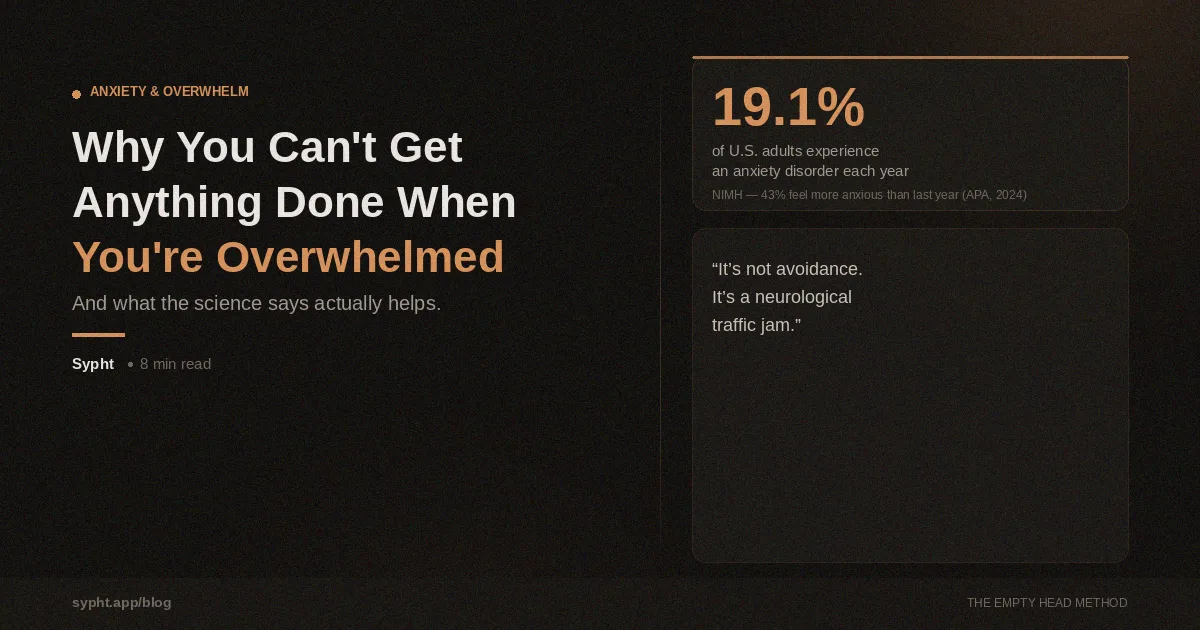
An estimated 19.1% of U.S. adults experience an anxiety disorder in any given year. And in 2024, 43% of American adults reported feeling more anxious than the year before, up from 37% in 2023 and 32% in 2022.
That's not a niche problem. That's nearly half the country feeling a measurable increase in anxiety, year on year.
But anxiety disorders and diagnosable conditions aside, overwhelm is even broader. You don't need a clinical diagnosis to recognise the feeling: too much on your plate, too many competing demands, a sense that everything is urgent and nothing is doable, and a brain that won't stop running through the list even when you desperately need it to stop.
Why does overwhelm make you freeze instead of act?
Here's what's actually happening when you're overwhelmed and can't start.
Anxiety doesn't just feel bad, it actively impairs your ability to think. Research has established a two-directional relationship between anxiety and working memory: anxiety impairs working memory function, and high working memory load can itself increase anxiety. They feed each other in a loop.
Working memory is your brain's active scratchpad, the cognitive system that holds information in mind while you use it. It's what lets you keep the ten things you need to do mentally "visible" while you decide which one to tackle. When anxiety floods this system, capacity drops. You can hold fewer things in mind clearly. Decisions become harder. The effort required to just choose what to start feels insurmountable.
And here's the cruel irony: the more things you're trying to hold in your head, the more anxious you get. The more anxious you get, the less capacity you have to hold things in your head. The less capacity you have, the more everything feels urgent and unmanageable. Round and round.
Traditional advice, "make a to-do list," "prioritise," "just pick one thing", assumes your working memory is functioning normally and can handle the task of sorting, ranking, and deciding. When you're overwhelmed, it can't. The advice fails at the first step, which makes you feel worse, which makes it harder to start, which makes the list feel more overwhelming.
This isn't weakness. It's a neurological traffic jam.
The Thought Spiral That Keeps You Stuck
Overwhelm does something else too: it makes you catastrophise the list.
When you're functioning well, "call the dentist" is a 3-minute task. When you're overwhelmed, "call the dentist" sits on the list next to forty other things, and your brain treats the pile as a single undifferentiated mass of obligation. Everything feels equally urgent. Nothing feels startable. You avoid the list entirely because looking at it makes the anxiety spike.
This avoidance is completely rational, you're protecting yourself from a feeling of threat. But it has a cost. The list keeps growing in your head even when you're not looking at it. Open loops drain cognitive energy continuously. The things you haven't done weigh on you even while you're trying to rest.
Psychologists call this the Zeigarnik effect: unfinished tasks occupy mental bandwidth disproportionately until they're either completed or externalised somewhere you trust. Your brain keeps pinging you about them because it's trying to make sure you don't forget.
When you have ten unfinished tasks, that's ten background processes running. When you have forty, it's forty. No wonder thinking feels slow and starting feels impossible.
What actually helps when you are overwhelmed?
The research on this is consistent and clear. Cognitive offloading, the use of external systems to reduce the information-processing demands on your brain, measurably reduces cognitive demand and frees up mental resources for active tasks.
In plain terms: the act of getting things out of your head and into a reliable external system quiets the background noise. Your brain stops trying to hold everything because it knows the things are somewhere safe.
This is why journaling helps. Why talking it out helps. Why simply writing a thought capture on a piece of paper before bed can let you sleep when nothing else could. You're not solving the problems, you're offloading them from your working memory to a system your brain trusts to hold them.
The challenge is that traditional productivity systems make cognitive offloading harder than it needs to be. They ask you to organise as you capture, to categorise, prioritise, tag, and structure your thoughts at the moment when your brain is least capable of doing any of that. It's like asking someone to sort the laundry while they're in the middle of an anxiety spiral. Technically possible. Practically brutal.
A Different Model: Capture First, Think Later
What if the system did the organising for you?
This is the core principle behind Sukima and The Empty Head Method. The idea is simple: your one job is to get everything out of your head. Say it, type it, stream it, all of it, unfiltered, in any order. The chaotic half-thought "I need to call the insurance company about that thing from last month, and also I haven't replied to Sarah, and I think the car needs an oil change" counts. You don't need to know the category or the priority. You just need to say it out loud.
Sukima's AI processes that stream and does the rest: extracting each distinct task, categorising it, assigning a priority, generating concrete next steps, and surfacing what's actually due soon. No decisions required from you at your lowest capacity moment.
What you get back isn't another overwhelming list. It's a structured, organised set of tasks, and crucially, a single recommendation for what to do next based on how much time and energy you have right now.
When everything is out of your head and organised, the anxiety quiets. Not because the tasks are done, but because your brain has been released from the job of holding them. The background processes stop. You can think again.
The Pick Moment
Clearing your head is step one. But there's still the problem of starting.
For people experiencing overwhelm, staring at even a well-organised list can still trigger paralysis. Too many choices. Too many things that feel important. The decision of which one to do first carries more weight than the tasks themselves.
Sukima's Pick feature removes that decision entirely. You tell it three things: how much time you have, your current energy level, and where you are. It gives you back one task, not a list, a single task, with a clear reason why. "This is due today." "You have the energy for this and it will take 20 minutes." "You can do this from here."
One task. One starting point. The paralysis has nothing to hold onto.
Do you need to be calmer before you can get started?
There's a common assumption that you need to deal with the anxiety before you can be productive. Meditate first, calm down, then tackle the list. That approach is backwards for a lot of people, the anxiety doesn't lift until you've made a dent in the pile, but you can't make a dent until the anxiety lifts.
Cognitive offloading breaks that cycle from the other direction. You don't start by trying to calm your brain. You start by emptying it. The calm follows.
download it from the App Store
Sukima is on the App Store today. If overwhelm is something you know too well, give it a try and start clearing your head today.
Sources:
National Institute of Mental Health. Any Anxiety Disorder. NIMH Statistics.
American Psychiatric Association. Annual Mental Health Poll, 2024.
Sarigiannidis et al. Does Overloading Cognitive Resources Mimic the Impact of Anxiety on Temporal Cognition? PMC, 2021.
Risko, E.F. & Gilbert, S.J. Cognitive Offloading. Trends in Cognitive Sciences, 2016.