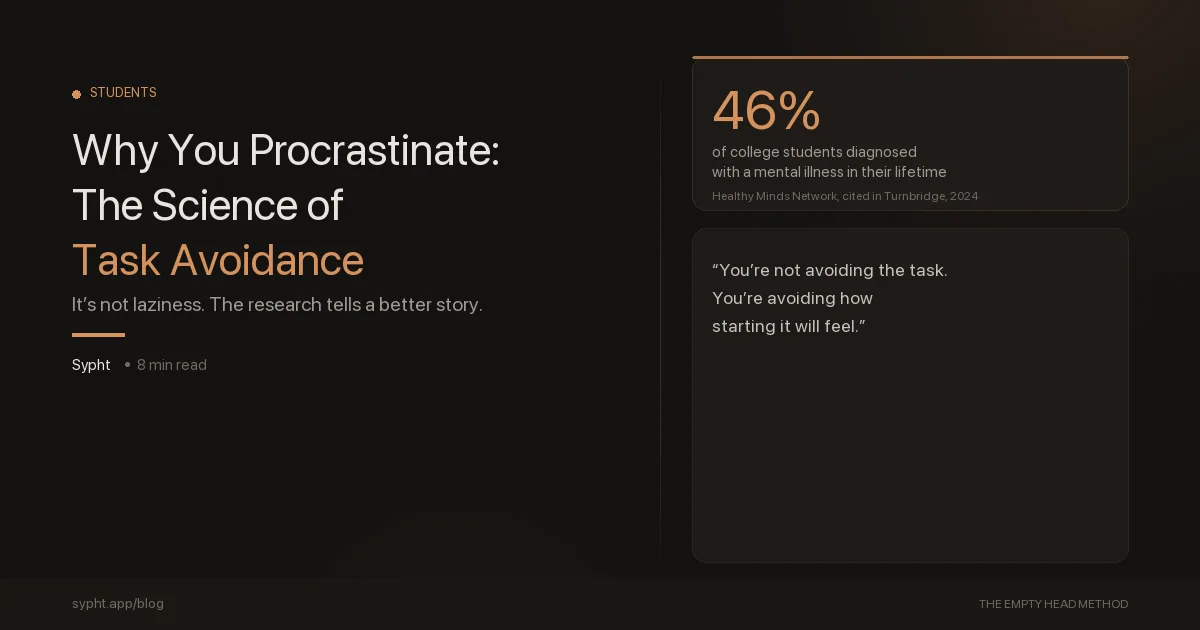
Procrastination costs students more than they usually calculate.
The immediate cost is obvious: work that doesn't get done on time, or gets done worse because it was compressed into less time than it needed. But the ongoing cost is less visible, the background anxiety of knowing the thing is still undone, the degraded focus that comes from carrying multiple unstarted tasks in working memory, the cumulative erosion of confidence that happens when the pattern repeats semester after semester.
Understanding why procrastination actually happens, not the folk psychology version, but what the research shows, changes both how you think about it and what you can actually do about it.
What Is Procrastination Actually?
The standard explanation for procrastination is poor time management, people don't plan well, underestimate how long things take, and run out of time.
This explanation is incomplete at best. Research by psychologist Piers Steel, who conducted one of the most comprehensive analyses of procrastination literature, found that procrastination is more accurately understood as an emotion regulation problem than a time management problem.
People procrastinate not because they don't know how much time they have, but because starting a task triggers an unpleasant emotional response, anxiety, boredom, frustration, self-doubt, perfectionism-driven dread, and avoiding the task avoids the feeling.
This is a rational short-term response to an immediate emotional stimulus. The problem is that avoidance doesn't eliminate the source of the anxiety, it defers it while adding its own anxiety on top (the awareness that you're not doing the thing, which generates its own negative feeling).
The procrastination cycle: task generates uncomfortable feeling → avoidance provides immediate relief → awareness of avoidance generates new discomfort → discomfort about avoidance makes approaching the task feel more loaded → task generates even more uncomfortable feeling.
Why Students Are Particularly Vulnerable
Several features of college life make procrastination more likely than in most other environments:
Autonomy without structure. College is the first environment where most students have full control of their time and no external authority enforcing deadlines in real-time. This is genuinely new territory, and the brain's default response to unstructured freedom and self-imposed deadlines is often avoidance, especially when the deadlines are weeks away.
Academically challenging material. The work is harder than before. Starting a task that might expose the limits of your understanding is more emotionally loaded than starting something you're confident you can do. The difficulty becomes an avoidance trigger.
Social density. College environments are full of immediate, rewarding social options that compete with the deferred reward of academic work. The brain, given a choice between an immediate enjoyable option and a later-rewarding effortful one, has a well-documented tendency to choose immediacy.
ADHD prevalence. Research consistently shows that 2–8% of college students have clinical ADHD, and ADHD is specifically associated with difficulty initiating tasks, especially tasks that aren't immediately engaging. For these students, procrastination isn't just a bad habit, it's a symptom of executive function impairment.
The ACHA National College Health Assessment found that 76% of college students report procrastination as one of their most significant academic challenges. This isn't a minority problem, it's the norm.
The Emotional Difficulty of Starting
Here's a distinction that makes a practical difference: the emotional resistance to starting a task is almost always greater than the emotional experience of doing it.
Most students who describe an assignment as "terrible" or "impossible" and avoid it for three weeks find, once they actually sit down and start, that it's not nearly as bad as anticipated. The dread was worse than the reality.
This is a well-documented bias in affective forecasting, we're poor at predicting how we'll feel during an experience. We overweight the anticipated negative feelings associated with a challenging task and underweight the actual experience of engagement with it.
Knowing this is useful because it reframes what initiation actually requires. You're not being asked to commit to the full experience of writing the essay. You're being asked to commit to the first five minutes, which will almost certainly feel less bad than anticipated and may generate enough momentum to continue.
The initiation is the hard part. Once it's started, the task loses a significant portion of its emotional charge.
How Does Task Vagueness Drive Procrastination?
A specific, underappreciated driver of procrastination is task vagueness.
"Work on the essay" is not a task in a psychologically meaningful sense. It has no clear starting point, no defined scope, and no completion marker. When you sit down to "work on the essay," you first have to figure out what you're going to do, which generates decision cost, which generates friction, which generates avoidance.
Compare this to "write the thesis statement for the history essay, just one sentence." This has a clear start, a defined scope, and a clear completion marker. The friction is dramatically lower.
Research on task initiation confirms this intuition: specificity reduces avoidance. The more concretely defined the first action, the more likely it is to be started.
This is the practical case for AI-generated step breakdowns. When a vague task, "research for the chemistry paper," "prepare for the econ presentation", is automatically converted into three to five concrete, time-estimated first actions, the most common avoidance trigger is removed before you have to engage with it.
The Temporal Distance Problem
Deadlines that are far away don't feel urgent. The brain is poorly calibrated for long-horizon threats, it responds to immediacy, not importance.
An assignment due in six weeks registers as "something to think about later." An assignment due tomorrow registers as a crisis. These are often the same assignment, with six weeks of avoidance in between.
This isn't irrational, it's how human motivation is wired. Temporal discounting, the tendency to value immediate things over future things, is a robust and well-replicated psychological phenomenon.
For students managing multiple assignments across multiple classes with varying deadlines, this bias systematically under-weights work that isn't yet urgent. The way to counteract it isn't willpower, it's bringing the deadline closer in a psychological sense.
Concrete strategies that help: set your own internal deadline that's earlier than the real one. Break the distant assignment into steps with their own near-term deadlines. Find an accountability structure, telling someone else when you'll have a specific piece done makes the deadline feel more real.
What Does the Research Say Actually Helps?
The research on effective procrastination interventions converges on a few consistent findings:
Implementation intentions. Making a specific plan, "I will do X on Wednesday at 3pm in the library", dramatically outperforms vague intentions to work on something. The specificity creates a bridge between intention and action that general resolve doesn't.
Reducing task aversiveness. Since procrastination is partly driven by the emotional load of a task, anything that reduces the perceived emotional cost of starting helps. Breaking tasks into smaller steps, reframing the task's meaning, starting with the parts you find less aversive.
External commitment. Telling someone else what you're going to do, when, and asking them to check. External accountability provides the urgency signal that deadlines weeks away don't generate naturally.
Self-compassion. Counterintuitively, being hard on yourself for procrastinating tends to increase procrastination. Research by Wohl, Pychyl and Bennett (2010) found that students who forgave themselves for procrastinating on a first exam were less likely to procrastinate on the second. Guilt is a poor motivator; it generates avoidance of the associated task rather than engagement with it.
download it from the App Store
Sukima is on the App Store today. For students who need a clearer path from "I need to do this" to "I've started."
Sources:
Steel, P. The Nature of Procrastination: A Meta-Analytic and Theoretical Review. Psychological Bulletin, 2007.
Wohl, M.J.A., Pychyl, T.A. & Bennett, S.H. I forgive myself, now I can study. Personality and Individual Differences, 2010.
American College Health Association. National College Health Assessment, Spring 2022.
Levin et al. College Students: Mental Health Problems and Treatment Considerations. PMC, 2015.