You've tried the systems.
Time-blocking. GTD. The One Thing. Deep Work. A Notion database so elaborate it became its own full-time job. You probably spent a weekend setting one of them up, felt briefly like a person who has their life together, and then watched it fall apart within two weeks the moment real life, a client emergency, a product fire, a hiring decision that couldn't wait, collided with the system.
You concluded the system was wrong, found a better one, repeat.
Here's the thing: the system probably wasn't wrong. The problem is that productivity systems designed for knowledge workers were not built for the particular cognitive conditions of running a business. And until you understand what those conditions actually are, you'll keep retrofitting solutions that don't quite fit.
The Numbers Are Stark
According to research surveying entrepreneurs, 87.7% struggle with at least one mental health issue, with anxiety, high stress, financial worries, burnout, and impostor syndrome each affecting more than 30% of respondents.
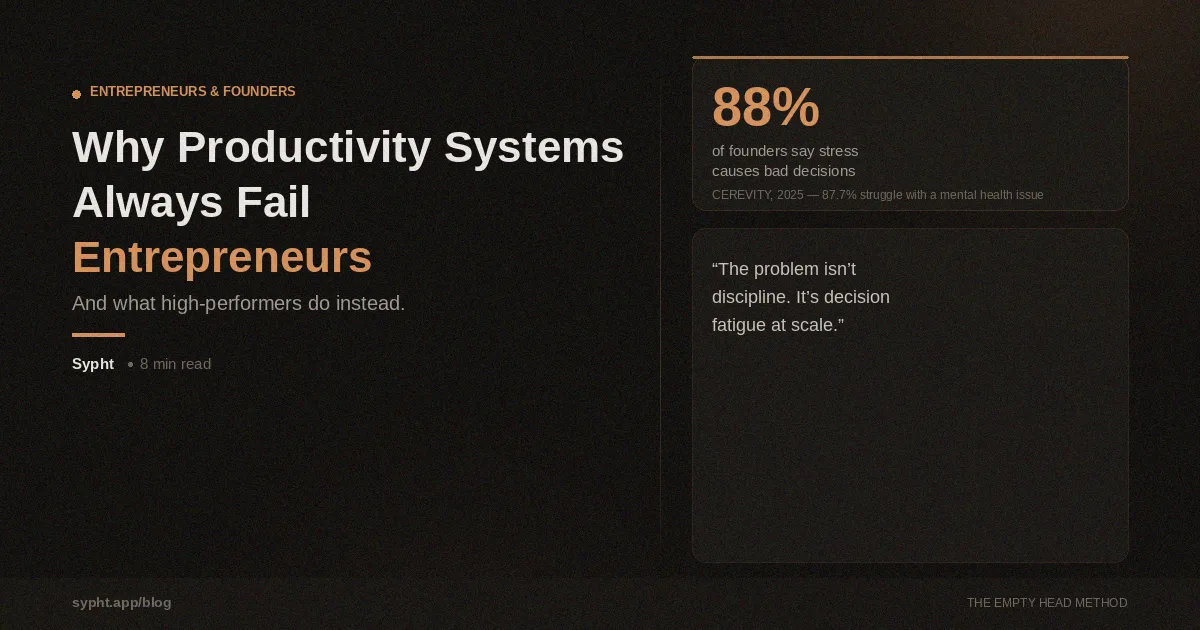
A separate survey of tech founders found that 88% agree that excessive stress results in bad decision-making. That's not a minor problem. If the decisions you make while running depleted, about hiring, product direction, fundraising, pricing, are impaired by stress, then the single highest-leverage investment you can make as a founder isn't in your product. It's in your cognitive state.
Entrepreneurs working without clear goals or priorities experience 40% higher burnout rates than those who have them.
That last statistic is particularly interesting because it reframes the burnout problem. It's not just about working too many hours. It's about decision fatigue, about the cognitive cost of figuring out what to do next, over and over, without a clear system to answer that question.
The Real Problem: Decision Fatigue at Scale
Employees, by and large, have their priorities set for them. They have managers, meeting agendas, deadlines that come from elsewhere. The number of decisions they need to make about what to work on is relatively low.
Entrepreneurs make that decision constantly. Every context switch, from product to sales to people to finance to operations, requires a full re-prioritisation. What's most urgent right now? What would be highest leverage? What's going to blow up if I don't deal with it today?
Each of those decisions carries a cognitive cost. And unlike a standard knowledge worker who might make a few of them per day, a founder might make dozens. By the time you've navigated the morning and it's 2pm, you're already running on a deficit, and the most important strategic work of the day still hasn't happened.
This is what decision fatigue actually looks like in practice for entrepreneurs: not the inability to make decisions, but the gradual degradation of decision quality as the day progresses. The meeting you scheduled for 4pm where you said yes to something you shouldn't have. The email you dashed off and immediately regretted. The strategy session that turned into a vague, inconclusive discussion because nobody had the cognitive bandwidth to push through.
Why Can't Your Current Productivity System Keep Up?
Traditional productivity systems have a fundamental mismatch with entrepreneurial work: they're designed for stable contexts.
GTD works brilliantly if your inbox, your projects, and your responsibilities stay roughly consistent. Time-blocking works if you control your calendar. The One Thing works if you have the luxury of choosing your focus for the day.
Entrepreneurial life is none of these. Your inbox changes character daily. Your priorities shift based on conversations that happened an hour ago. Your "one thing" gets interrupted seventeen times by things that are actually urgent. The context-switching isn't a bug, it's the job.
So what happens? You build the system, the system demands consistent inputs in a consistent format, the business demands something different, the system breaks, you abandon it and feel like you failed, you try the next one.
The problem isn't your discipline. The problem is that these systems require low-friction, consistent input from a person operating in a high-friction, inconsistent environment.
What Does Holding It All in Your Head Cost You?
There's a second problem, quieter but equally damaging.
When a system breaks down, things migrate back to your head. The call you need to make, the decision you've been putting off, the hire you know you need to think about, the investor update that's overdue, all of it starts living in working memory because there's nowhere trusted to put it.
This is expensive. Working memory has limited capacity, and every "open loop", every unresolved task or commitment, occupies a slice of that capacity continuously. Entrepreneurs tend to accumulate open loops faster than most people because the surface area of their responsibilities is so much larger.
The result isn't just stress. It's a subtle but persistent drag on cognitive performance: slower thinking, more distraction, poorer decisions. The very things that make you effective as an entrepreneur are being quietly eroded by the weight of what's in your head.
What Do High-Performing Founders Do Differently?
The pattern that consistently shows up in founders who stay productive under pressure isn't a particular system or methodology. It's a behaviour: they get things out of their head fast and completely.
They capture ruthlessly, the thought that occurs in the middle of a meeting, the thing they remembered in the shower, the follow-up they know they'll forget. They don't try to process or prioritise at the moment of capture. They just get it out of their head and into something they trust to hold it.
The difference between high-performing founders and struggling ones often isn't intelligence or work ethic. It's the size of the gap between "thought occurs" and "thought is captured." For the former, that gap is seconds. For the latter, it's hours, and a significant percentage of those thoughts are lost entirely.
Sukima: Built for the Entrepreneurial Context
Sukima is built on a single insight: the capture problem for entrepreneurs needs to be essentially frictionless, and the organising work needs to happen automatically.
You open the app, or say "Hey Siri, capture this in Sukima", and you stream whatever's in your head. The Monday morning thought capture. The three things that occurred to you in the middle of your last investor call. The growing pile of "I should deal with that" items that have been bouncing around for a week.
Sukima's AI processes that stream and organises everything automatically: extracting each distinct item, categorising it, assigning a priority, and generating concrete next steps. In the time it would take to open Notion and figure out which database the item belongs in, you've captured twelve things, had them organised, and closed the app.
When you have a gap, 30 minutes between calls, an afternoon slot that opened up unexpectedly, you don't have to figure out what to do with it. You tell Sukima how much time and energy you have, and it picks one thing. Not a list. One clear, reasoned recommendation.
This is the gap-time problem most founders never solve. The time is there. The energy to make a good decision about what to do with it isn't.
The Real ROI
The case for this isn't about productivity for productivity's sake. It's about decision quality.
If 88% of founders agree that excessive stress degrades their decisions, and the primary driver of that stress is cognitive overload from carrying too much in their heads, then clearing that load isn't a productivity hack. It's a business decision.
The hiring decision you made when you were running on empty. The pricing call you second-guessed for a week. The partnership you didn't fully think through. A clearer head would have handled all of those better. That's the ROI.
download it from the App Store
Sukima is on the App Store today. If you're building something and your head is full, give it a try.
Sources:
Founder Reports. 17 Mental Health Statistics for Entrepreneurs, 2025.
CEREVITY. Tech Founder Burnout Statistics 2025: 73% Report Hidden Mental Health Crisis.
Gitnux. Entrepreneur Burnout Statistics, 2025.