Nobody tells you how hard it is to manage your own life for the first time.
Not the administrative complexity of it, the class schedules, the financial aid forms, the meal planning, though that's real. The part nobody prepares you for is the cognitive complexity. The experience of being entirely responsible for tracking everything, prioritising everything, and deciding what to do with your time, all the time, with nobody to catch you when something slips.
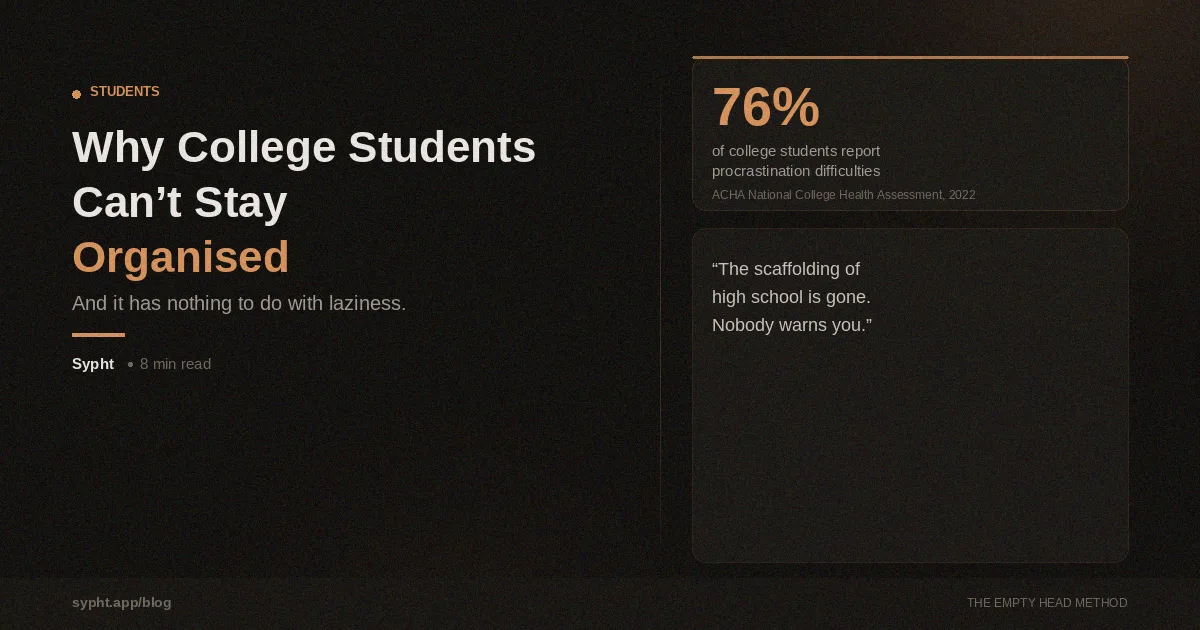
In high school, the structure was built in. Bells told you where to be. Parents reminded you about deadlines. Teachers followed up when assignments were missing. That scaffolding was invisible precisely because it was always there.
College removes it. Entirely. Often in a single week.
And then people act surprised when students fall apart.
The Numbers
Close to half of modern college students, 46%, have been diagnosed with a mental illness in their lifetimes, according to data from The Healthy Minds Network.
Among college students, 13% report experiencing ADHD or ADD, and 76% report challenges with procrastination as one of their top academic difficulties.
Between 2% and 8% of college students have clinical ADHD, and approximately one quarter of students receiving disability services have ADHD. But the ADHD numbers, significant as they are, don't capture the full picture. Students without any diagnosis struggle with the same underlying problem: a sudden, dramatic increase in the amount of cognitive self-management required, without any increase in the tools or training to handle it.
What Actually Changes Between High School and College?
In high school, the structure of the day did a lot of your cognitive work for you. You didn't have to decide when to study because you had class. You didn't have to track deadlines because they were written on the board. You didn't have to remind yourself about the test next week because the teacher reminded the class.
In college, the structure is gone. You have three classes on Tuesday and nothing on Wednesday. Your professor posted the assignment schedule on week one and hasn't mentioned it since. Your roommate has a completely different timetable. Every day, the first decision you need to make is "what should I do now?", and there's no external input to help you make it.
This doesn't sound like a big deal until you realise how many decisions you're now making each day that you weren't making before. What time to wake up. What to eat. What to work on and for how long. Which assignment to prioritise. Whether to go to the optional study session. Whether the thing you told yourself you'd do "later" is going to actually happen or not.
Each of these is a small decision. Cumulatively, they're exhausting.
Why Do Students Procrastinate Even When They Want to Work?
Here's something nobody tells students about procrastination: it's usually not about the task.
It's about the decision. Specifically, the decision about where to start.
When you sit down to work and have three assignments due this week, four readings you're behind on, and an email from your professor you haven't opened, the experience isn't "I need to work", it's "I need to figure out what to work on." And that decision, sorting through competing priorities, estimating time required, factoring in difficulty and urgency, is genuinely hard when your working memory is already taxed by the weight of everything you're carrying.
The easier path, neurologically, is to not decide. Open your phone. Scroll. Watch one episode. The decision is deferred, the relief is immediate, and the anxiety about the work grows quietly in the background.
This isn't laziness. It's a reasonable response to decision overload.
The Vanishing-Thought Problem
There's another issue specific to students: the timing mismatch between when thoughts occur and when you can act on them.
You're walking between classes and you remember the paper you need to start. You're in a lecture and realise you forgot to email your advisor. You're in the shower and three things you need to do suddenly surface, clear and urgent, and then you get dressed and one of them is already gone.
The ADHD community has a phrase for this: "if it's not in front of me, it doesn't exist." But variations of this experience affect students broadly, the thought occurs at the wrong moment, there's no immediate place to put it, and by the time you're somewhere that could act on it, the thought has dissolved.
This is where voice capture changes things. The moment the thought occurs, walking across campus, between buildings, waiting for coffee, you say it out loud, it's captured, and your brain can let it go. No stopping to type, no finding the right app, no deciding what category it belongs to. The thought is out of your head before it can vanish.
What Do Students Actually Need From a Productivity Tool?
Most productivity apps are designed for the kind of sustained, predictable focus that college students rarely have.
You don't always have two uninterrupted hours. You have 45 minutes between classes and a brain that's still processing the lecture you just left. You have a free afternoon that appeared suddenly when a class was cancelled. You have Sunday night when you know you should do something but the pile feels so big you don't know where to start.
What students need isn't a perfect system. It's something that answers three questions clearly, on demand:
What do I actually need to do?
What should I do with the time I have right now?
Where do I even start on the big thing I've been avoiding?
Sukima is built to answer all three.
The thought capture captures everything, the scattered thoughts, the half-remembered deadlines, the ideas about the essay you haven't started. The AI organises it automatically, generates concrete first steps for the things you've been avoiding, and surfaces what's actually most urgent.
When you have a gap, 40 minutes at the library before your next class, you tell Sukima how much time you have and your energy level, and it gives you one thing to do. Not a list. One clear task with a reason.
That's all your brain needs to start.
Breaking Down the Big Things
One of the most specific ways Sukima helps students is with task initiation on large, vague assignments.
"Write research paper" is not a task. It's a category of suffering. Your brain can't start on it because it can't find an edge, a clear, bounded first action that you could actually do in the next 30 minutes.
Sukima's AI step generation converts vague obligations into concrete first steps: "Open a new document and write the thesis question in one sentence." "Find three sources on the primary topic." "Write 200 words summarising what you already know before you research further." Each step is specific, time-estimated, and completable.
The research paper stops being a wall and becomes a sequence of things you actually know how to do.
You're Not Behind Because You're Bad At This
The systems that worked in high school won't work in college. The cognitive demands are categorically different. The support structures are gone. The sheer volume of self-management required is higher than it's ever been, and you're expected to figure out how to handle it with no training and a lot of competing pressures.
Most students aren't struggling because they're lazy or uncommitted or wrong for college. They're struggling because the gap between what their brains were trained to handle and what college actually requires is enormous, and nobody built them a bridge.
Sukima is part of that bridge.
download it from the App Store
Sukima is on the App Store today. If you're in college and your head is perpetually full, give it a try.
Sources:
The Healthy Minds Network. College Student Mental Health Data, cited in Turnbridge (2024).
American College Health Association (ACHA). National College Health Assessment, Spring 2022.
Levin et al. College Students: Mental Health Problems and Treatment Considerations. PMC, 2015.