It's 7am on a Tuesday.
You've already remembered that your daughter needs her permission slip signed, that you're out of milk, that the car is due for a service, that you haven't replied to your mother in four days, that there's a work presentation Thursday you haven't started, that your son has football on Saturday and you need to figure out who's doing pickup, and that you said you'd bring something to the school bake sale, you just can't remember what or when.
You haven't had coffee yet.
This is the mental load. Not the tasks themselves, the relentless, invisible, background processing of keeping a household running. The planning, the tracking, the remembering, the anticipating, the coordinating. The fact that while you're doing one thing, you're simultaneously maintaining a running inventory of twelve other things that need doing.
This Isn't Just Stress, It's a Documented Phenomenon
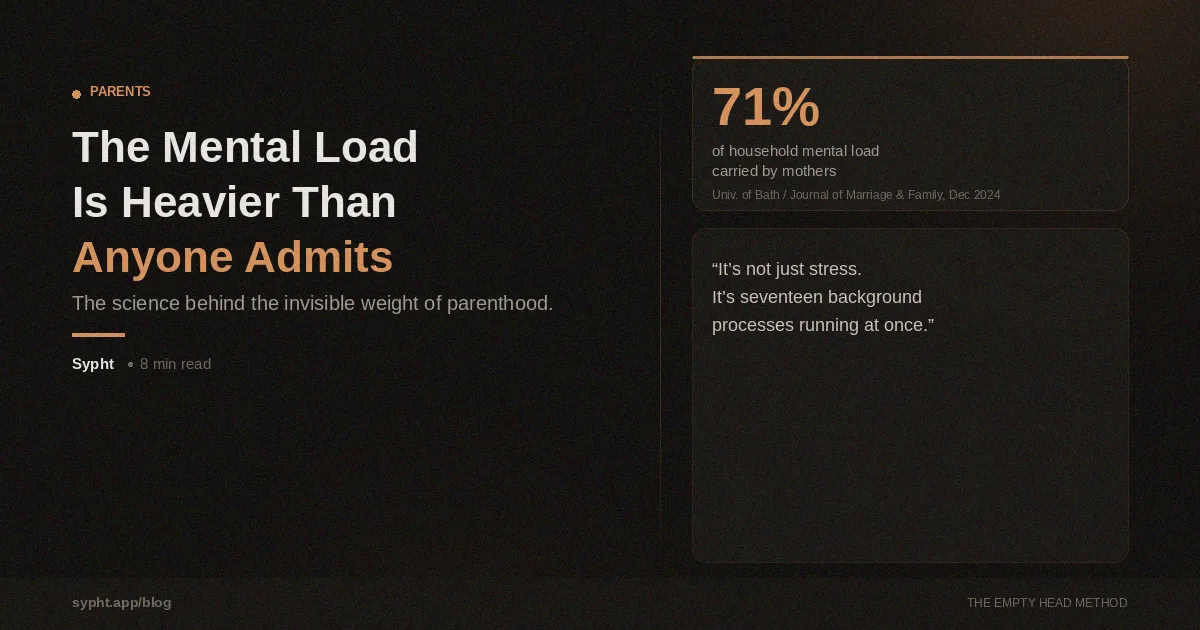
A 2024 study published in the Journal of Marriage and Family, conducted by researchers at the University of Bath and the University of Melbourne, surveyed 3,000 U.S. parents and found that mothers carry 71% of all household mental load tasks, 60% more than fathers. This includes not only daily tasks like childcare and cleaning, but the scheduling, planning, and organising work required to keep family life functioning.
Mothers manage 79% of repetitive daily responsibilities, over twice the rate of fathers, while still carrying 53% of episodic tasks like finances and home repairs, leading to significant duplication of effort.
These numbers matter not because they're about fairness (though they are), but because they quantify something that often goes unacknowledged: this is actual cognitive work. It takes up real mental bandwidth. It interferes with everything else you're trying to do. And it doesn't stop when you're doing something else.
Why doesn't the mental load feel like work?
One of the most frustrating aspects of the mental load is its invisibility, even to the person carrying it.
When you sit down to work and you can't focus because your brain keeps interrupting with "you need to book that dentist appointment," that's not distraction. That's your working memory doing what it was designed to do: flag unresolved tasks so you don't forget them.
Your brain treats every open loop, every remembered task, uncommitted obligation, or unscheduled appointment, as an active process. It keeps those processes running in the background, surfacing them at intervals to make sure you haven't forgotten. When you have seventeen open loops, you have seventeen background processes. The cognitive cost is real and continuous.
This is why parents, particularly those carrying a disproportionate share of the mental load, often describe feeling exhausted before anything has actually happened. They're running at a deficit before the day starts, not because they're weak or bad at managing stress, but because their working memory is genuinely overwhelmed by the sheer volume of unresolved items they're tracking.
Why do you keep forgetting things you know you need to do?
Here's what happens in practice.
You're changing a nappy and you think: I need to call the GP surgery about that referral. Important thought. But you're mid-nappy and your hands are full and by the time you're done and the baby is settled, the thought has been displaced by five other things that needed your attention in between.
The referral stays on the mental list. It joins the fifteen other things that are on the mental list. The mental list has no structure, no priority ordering, no way of surfacing the most important item when you have a free moment. It's a pile in your head, not a system.
Traditional solutions, notebooks, apps, whiteboard lists, ask you to add one more step: when the thought occurs, stop what you're doing and write it down. But you're rarely in a position to stop what you're doing. You're mid-cooking, mid-conversation, mid-bedtime routine, mid-everything. The friction between "thought occurs" and "thought is captured" is high enough that a significant percentage of thoughts are never captured at all.
They stay in the pile. The pile gets heavier.
The Problem With Existing Productivity Tools
Most task management apps were designed for individual knowledge workers with relatively stable schedules and predictable workloads. They're optimised for people who can sit down, open the app, review their system, and plan their day.
This description applies to almost no parent of young children.
Your schedule isn't predictable. Your interruptions aren't scheduled. The moment you have to plan anything, something else needs your immediate attention. The apps that require structured input, "add a task, assign a category, set a due date, add to a project", create more friction than they solve when your hands are literally full and your attention is being actively claimed by a small person who needs something right now.
And even when you do get the things into the system, you're left with a list, and a list doesn't tell you what to do with the 20 minutes that just opened up when the kids went down earlier than expected. A list is just the pile, but in a different format.
What actually helps with the mental load?
There are two things parents consistently say they need from a productivity system, and they're almost never both delivered at once.
The first is zero-friction capture. The ability to get a thought out of your head in the moment it occurs, without stopping what you're doing, without finding the app, without structuring the input. Voice is the obvious solution, but only if the system does something useful with what you said.
The second is automatic next-action selection. Not a list to manage. A clear answer to "I have 20 minutes and low energy, what should I do right now?"
Sukima is built around both of these.
You say "Hey Siri, capture this in Sukima" while you're making breakfast, and the thought, however disorganised, is captured. Later, Sukima's AI has parsed everything you've offloaded, extracted each distinct task, assigned priorities, and generated concrete first steps. When the gap appears, you open the app, tell it how much time and energy you have, and it tells you one thing to do.
Not seventeen things. One.
The Thing Nobody Tells You About Mental Load Relief
Reducing the mental load isn't just about getting more done. It's about the quality of what you do when you are present.
When you're playing with your kids but seventeen background processes are running, you're physically there but mentally somewhere else, half-listening, half-planning, half-anxious. The quality of presence suffers. The thing you're most trying to protect, the actual time with your family, is quietly compromised by the weight of everything you haven't resolved yet.
Getting that weight out of your head doesn't just make you more productive. It makes you more present. It's the difference between "I'm here but also I need to remember about the permission slip" and actually being here.
That's the real value. Not the tasks. The headspace.
download it from the App Store
Sukima is on the App Store today. If you're a parent and you know exactly what the mental load feels like, give it a try.
Sources:
Catalano Weeks, A. & Ruppanner, L. A typology of US parents' mental loads: Core and episodic cognitive labor. Journal of Marriage and Family, 2024.
Neuroscience News. Moms Carry 71% of the Mental Load. December 2024.
Psychology Today. Mental Load: The Invisible Weight of Parenthood. December 2024.