The conversation about the mental load usually happens in the context of home and family: the invisible work of running a household, the imbalance in who carries it, the toll it takes on rest and relationships.
Less discussed is what it does at work.
Because the mental load doesn't stop when you leave the house. It travels. And inside the office, or the home office, or the coffee shop, or wherever work happens, it quietly and measurably impairs the cognitive performance that professional success depends on.
Why does the mental load affect work? Working memory is a shared resource
Understanding why the mental load affects work requires understanding what working memory actually does.
Working memory is the cognitive system that holds information actively in mind for immediate use. It's what lets you follow a conversation while tracking what you need to say next. It's what keeps the thread of a complex project accessible while you work on its components. It's the cognitive substrate of attention, reasoning, and decision-making.
Working memory has limited capacity. It can hold a certain amount of information actively at any given time, and that amount is finite.
The mental load, the scheduling, planning, tracking, and anticipating required to manage household and family life, doesn't disappear when you sit down to work. It continues running as background processes in working memory: the appointment you need to rebook, the permission slip you haven't signed, the thing you promised your partner you'd sort out, the school pickup arrangement that changed yesterday. Each of these is an active process. Each one occupies a portion of working memory's finite capacity.
The result is that working parents, particularly those carrying a disproportionate share of the household mental load, arrive at work with less effective cognitive capacity than those who aren't managing an ongoing parallel inventory of household obligations. This isn't a matter of motivation or focus. It's a structural deficit created by a shared resource with competing demands.
What the Research Shows
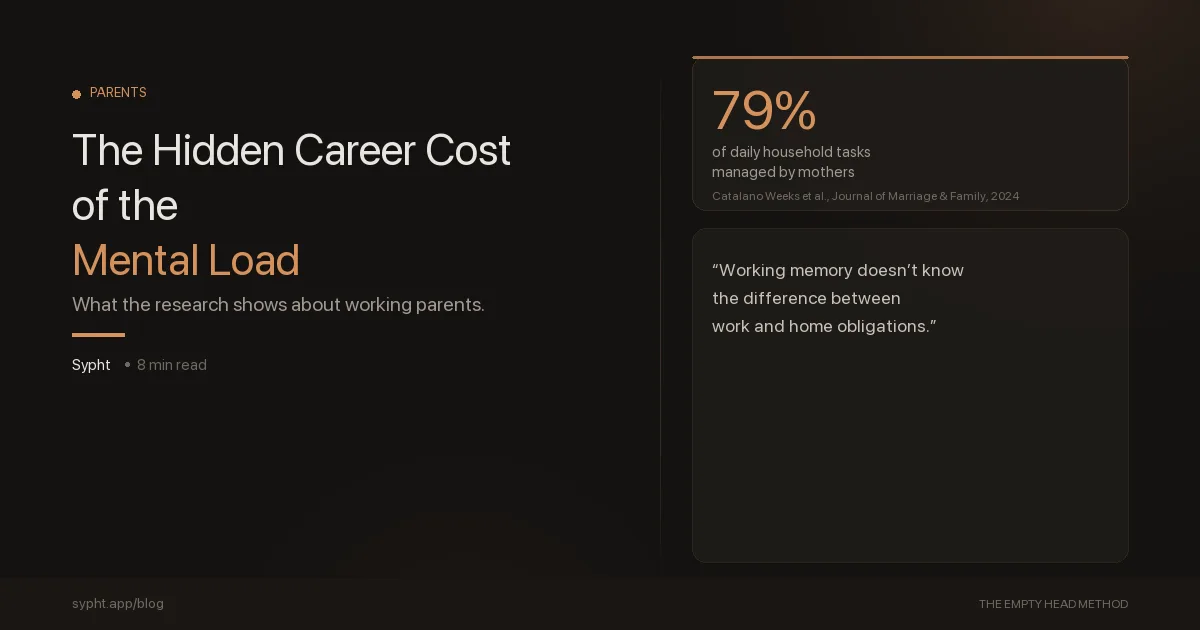
A 2024 study published in the Journal of Marriage and Family by researchers at the University of Bath and the University of Melbourne surveyed 3,000 U.S. parents and documented the scale of the mental load imbalance: mothers carry 71% of all household mental load tasks, including 79% of daily recurring tasks like childcare coordination and household management.
This imbalance has documented professional consequences. Research consistently links greater household mental load to reduced career advancement, higher rates of working part-time or stepping back from demanding roles, and higher burnout rates, particularly among mothers in dual-income households.
The mechanism is partly structural (reduced availability for professional demands when household demands are high) and partly cognitive (the mental load occupies working memory that would otherwise be available for professional work). Both effects are real, and the cognitive mechanism is often the less visible of the two.
Separate research on cognitive load in knowledge workers shows that performance on complex tasks, tasks requiring sustained attention, creative problem-solving, and strategic thinking, degrades significantly when working memory is already heavily loaded by other concurrent demands. The pattern holds whether those demands are professional or personal in origin. Working memory doesn't distinguish.
The Invisible Cognitive Tax
Here is what this looks like in practice.
A parent in a meeting is following the discussion and contributing effectively. In the background, a thread is running: the school called yesterday about something that needs addressing, the car service is overdue, the appointment needs to be changed. These threads don't intrude loudly. They operate below the level of conscious awareness. But they're there, consuming working memory resources that would otherwise be available for full engagement with the meeting.
This isn't distraction in the ordinary sense, the parent isn't thinking about the school call instead of the meeting. They're managing both simultaneously, at a cost that's distributed invisibly across everything.
Over a working day, this tax accumulates. By the afternoon, the cognitive deficit created by maintaining the household inventory alongside professional work has compounded into measurably reduced performance on exactly the tasks that matter most for career outcomes: complex reasoning, strategic thinking, creative problem-solving, effective communication.
The parent is working. But they're working harder for less output than they'd produce with unencumbered working memory.
Who bears this cognitive cost the most?
The data on mental load distribution makes clear that this cognitive tax is not equally distributed.
Women in dual-income households with children carry significantly more of the household mental load than their male partners, a finding that replicates consistently across studies and cultures, and that the 2024 University of Bath research quantified at 71% of household tasks in the U.S. sample.
This means the cognitive tax on working memory is disproportionately borne by women in these households. The career consequences are downstream of this cognitive impairment: it's harder to do your best work when more of your working memory is occupied.
This is not to say that fathers or others without the primary mental load share don't experience any cognitive tax, they do. But the magnitude differs, and the difference compounds over time into observable career outcome gaps that are often attributed to individual choices or preferences rather than cognitive load disparities.
What does cognitive offloading do for professional performance?
The research on cognitive offloading, the practice of externalising information into a reliable external system to reduce working memory load, shows consistent benefits for cognitive performance across a range of complex tasks.
When working memory is freed from the burden of actively maintaining open loops, tasks held in mind to prevent them from being forgotten, more capacity is available for the task in front of you. Complex reasoning improves. Attention quality increases. The quality of work produced in a given period of time goes up.
For working parents managing a high household mental load, cognitive offloading is not a productivity hack. It's a form of resource management. Getting the household inventory, all of it, not just the urgent parts, out of working memory and into a reliable external system before engaging with professional work is the cognitive equivalent of clearing your desk before starting.
You're not eliminating the household obligations. You're stopping the active, continuous monitoring of them during periods when professional work requires your full cognitive capacity.
The distinction matters. Parents who try to "leave it at the door" through willpower fail because the background processes continue running regardless of intention. Parents who externalise everything into a trusted system before engaging with work create the actual cognitive conditions that "leave it at the door" is trying to describe.
A Different Framing
The mental load is usually framed as a fairness problem, and it is. The distribution is unequal, the consequences are real, and the conversation about more equitable sharing matters.
But there's also a performance framing that gets less attention: carrying a disproportionate mental load impairs the cognitive performance of the people carrying it, and that impairment has tangible professional costs.
Addressing the mental load, whether through redistribution, externalisation, or both, isn't just a domestic equity issue. It's a professional performance issue. The people carrying the most cognitive household load are working harder than their colleagues at a demonstrable cognitive disadvantage, and this continues largely unacknowledged in both policy and practice.
download it from the App Store
Sukima is on the App Store today. For working parents who need their full brain at work.
Sources:
Catalano Weeks, A. & Ruppanner, L. A typology of US parents' mental loads: Core and episodic cognitive labor. Journal of Marriage and Family, 2024.
Risko, E.F. & Gilbert, S.J. Cognitive Offloading. Trends in Cognitive Sciences, 2016.
Neuroscience News. Moms Carry 71% of the Mental Load. December 2024.
Psychology Today. Mental Load: The Invisible Weight of Parenthood. December 2024.