Most college productivity advice assumes conditions that don't exist.
It assumes you have consistent chunks of uninterrupted time. That your energy is predictable. That your schedule is stable. That you can commit to a routine and maintain it across the constant variation of semesters, social obligations, part-time work, and everything else that makes up actual college life.
This advice is written for a fictional student with a stable 9-to-5 and nothing else going on. It's less useful for someone who has class at 8am on Monday and 2pm on Thursday, works Saturday, has different deadlines every week, and whose energy at any given time depends heavily on how last night went.
Here's what actually helps when the conditions aren't ideal, which is most of the time.
Accept That You Will Not Have a Perfect System
The first thing to let go of is the idea that there's a system out there that, once found and implemented, will make you consistently organised without ongoing effort.
There isn't. Systems require conditions to maintain, and college is a condition-disrupting environment. The semester that started with a clean planner and colour-coded notes will encounter a difficult week, a family thing, a social period, a class that's harder than expected, and the system will get behind, and behind is often experienced as failure, and failure is often experienced as abandonment.
What actually works is not one system, maintained perfectly. It's a few core behaviours, maintained imperfectly, with regular resets when things get off track.
The Two Non-Negotiables
Across everything else, two things consistently make the biggest difference for students:
1. Capture immediately, anywhere. The thought that occurs between classes, the assignment you just remembered, the question you want to ask, the thing you need to sort out, needs to leave your head before it disappears. Voice capture is the fastest method: say it into Sukima as you walk out of the building, before you've unlocked your phone and before anything else claims your attention.
The window between "thought occurs" and "thought is gone" can be seconds for students in high-stimulus environments. Capture has to be immediate and frictionless enough to beat that window.
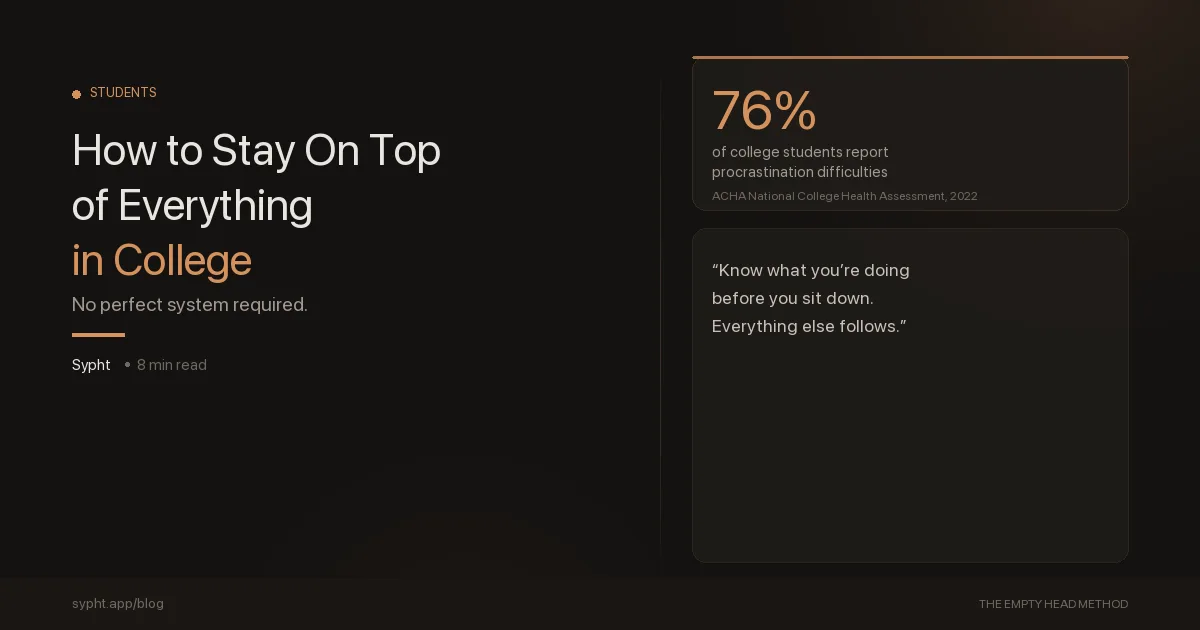
2. Know what you're actually doing before you sit down. The most common student productivity failure isn't lack of effort, it's sitting down to work without a clear answer to "what am I doing for the next hour?" The absence of that answer produces a decision process that's slow, uncomfortable, and often resolved by doing the easiest thing rather than the right thing.
Before you sit down, have one specific task with a clear next action. Not "study for bio." Not "work on the essay." "Read pages 80–110 of the bio textbook and take notes on the cell division section." Specific enough to start immediately.
How Do You Handle Big Assignments That Feel Impossible to Start?
Every semester there are two or three assignments that sit on the list for weeks without movement, not because you've forgotten them, but because every time you think about starting, the scale of the thing makes initiation feel impossible.
The standard advice is to break them into smaller pieces. This is correct but incomplete. The piece still needs to be small enough to actually start, not just smaller than the whole.
A 3,000-word essay is a large assignment. "Work on the essay" is not a task. "Write one paragraph explaining the main argument" is a task. "Find three relevant sources and note the key points from each" is a task. "Write the introduction, just 200 words, doesn't have to be perfect" is a task.
The gap between "the essay" and the actual first action is wider than most people realise. Sukima's step generation addresses this directly: give it the vague task and it returns three to five concrete, time-estimated first actions. The initiation barrier drops from a wall to a step.
What Should You Do With Gaps Between Classes?
College schedules are full of gaps, the 50 minutes between lectures, the afternoon a class got cancelled, the hour before the dining hall opens. These gaps often get wasted not because you don't intend to use them, but because you arrive at them without a clear answer to "what should I do with this?"
The decision costs time and cognitive fuel. By the time you've navigated it, the gap has shrunk.
Two things help. First, know before you arrive at a gap what's most appropriate for that gap, short and low-energy tasks for small or tired gaps, longer and focused work for large and alert gaps. Second, have a visible, already-curated list of tasks that fit each category.
Sukima's Pick function is built exactly for this: tell it how much time you have and your energy level, get back one specific task to do right now. No decision overhead. No deliberation. Just a clear next action.
The Weekly Reset
The most useful habit in college isn't daily, it's weekly.
Once per week, preferably at a consistent time (Sunday evening works well), spend 15 minutes doing three things:
Capture everything that's been accumulating: tasks you've been holding in your head, assignments coming up, things you've been meaning to sort out. Get it all out.
Look ahead at the next two weeks. What's due? What needs to start before the due date to not be a crisis? What commitments do you have that will affect available time?
Set three priorities for the coming week. Not a full plan, three specific things that need to happen. These anchor the week without requiring a perfect schedule.
This takes 15 minutes. It prevents a lot of Sunday-night panic, Monday-morning confusion, and the slow accumulation of dropped balls that builds into a crisis by Week 8.
What Should You Do When You're Behind?
At some point in every semester, things get off track. Assignments slip, the system falls apart, the pile feels too large to address.
The trap is treating this as failure that requires perfect recovery, rebuilding the full system before doing any work. The reset approach is simpler.
Stop. Do a complete thought capture of everything outstanding. Don't try to organise it or evaluate it, just get it all out of your head. Then ask: what is the single most important thing I need to do in the next 24 hours? Do that. Then the next. Don't try to recover the whole semester in an afternoon.
You're not rebuilding the system. You're just doing the next thing, then the next thing. The system comes back gradually, not all at once.
download it from the App Store
Sukima is on the App Store today. For students who need something that works in the actual conditions of college life.
Sources:
American College Health Association. National College Health Assessment, Spring 2022.
Risko, E.F. & Gilbert, S.J. Cognitive Offloading. Trends in Cognitive Sciences, 2016.
Steel, P. The Nature of Procrastination. Psychological Bulletin, 2007.