Most advice about managing the mental load of parenting involves fixing the conditions: get a more equal division of labour, find more time, build better routines, get a planner.
This advice isn't wrong. But it assumes conditions you may not have right now, a partner ready to recalibrate, schedule flexibility, the bandwidth to redesign systems from scratch.
The gap between "the conditions that would help" and "the conditions I actually have" can be enormous. And in that gap, the mental load doesn't pause and wait.
Here's what actually helps within the conditions you have, not the ones you wish you had.
The First Problem: You're Holding More Than You Think
One of the specific features of the mental load is that its full weight is often invisible, even to the person carrying it. The brain has been managing the inventory for so long that it happens automatically, the tracking of the dentist appointment, the school lunch situation, the thing your partner doesn't know needs doing yet, the thing your kid mentioned last week that you haven't followed up on.
This automatic management is efficient in a narrow sense. But it means the true volume of what you're holding is obscured. You know you're tired and overwhelmed, but the specific accounting of why is less clear.
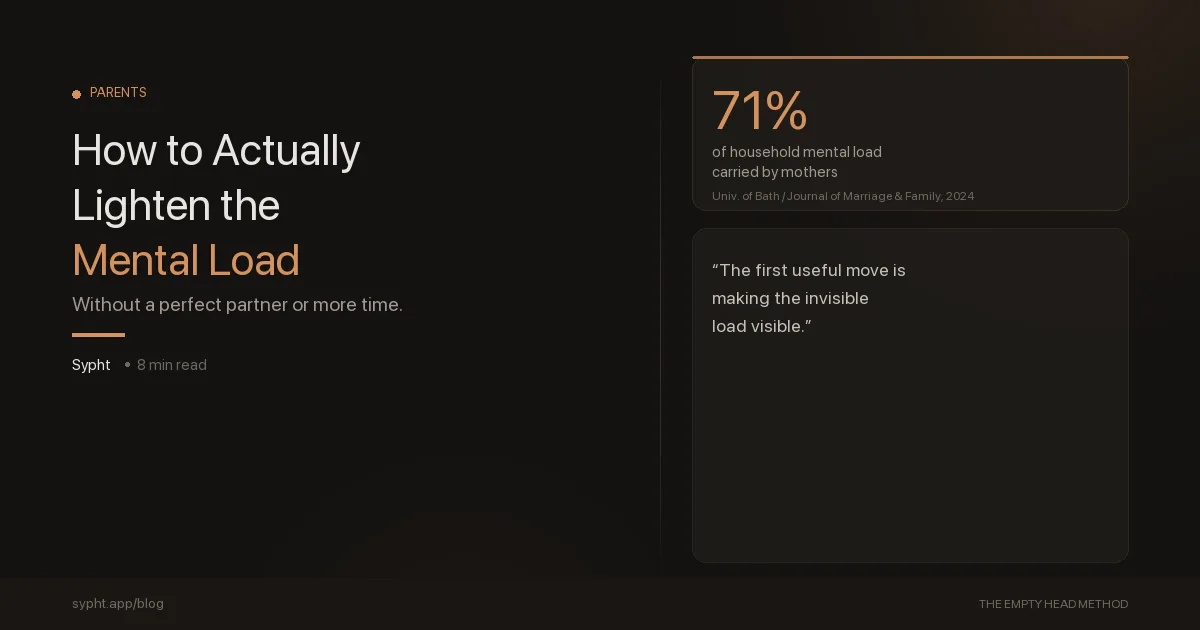
A complete thought capture, getting everything you're holding out of your head and into an external system in one go, is often the first genuinely useful move. Not because it solves anything, but because it makes the invisible visible. You can't address a load you can't fully see.
Most parents who do this for the first time are surprised at the volume. The relief starts before anything is done, simply because the pile is now outside the head rather than inside it.
Why Capture a Thought the Moment It Occurs?
The mental load accumulates because household and family management generates a continuous stream of tasks and obligations at moments when you can't act on them.
The thought occurs while you're changing a nappy, making breakfast, driving, in the middle of a work meeting. By the time you're in a position to deal with it, it's often gone, not forgotten exactly, but displaced to the back of the pile where it continues consuming cognitive resources without being addressed.
The answer is voice capture at the moment of occurrence. "Hey Siri, capture this in Sukima" while your hands are full, your attention is elsewhere, your phone is on the counter across the room. The thought leaves your head in the moment it arrives, before anything displaces it, without requiring you to stop what you're doing.
The friction has to be this low for it to work consistently in the actual conditions of parenting, where stopping what you're doing to open an app and type something is often simply not possible.
What Should You Do With a Gap When It Appears?
One of the most common experiences for parents is the unexpected gap, 20 minutes when the kids are occupied, half an hour when everyone is asleep, an afternoon that opened up. These gaps often get wasted because arriving at them without a clear answer to "what should I do with this?" leads to either anxiety-driven paralysis (the list is too big to choose from) or default scrolling (the brain takes the lowest-resistance option).
The solution is pre-loading. Not planning every gap in advance, but having a ready answer to "I have 20 minutes and low energy" that doesn't require you to evaluate the whole pile in the moment.
Sukima's Pick feature answers exactly this: tell it your available time and current energy level, and it returns one specific task, not a list, one task, that fits. No decision overhead. No weighing competing priorities. One starting point.
For parents, this transforms unexpected gaps from stressful decision moments into usable time. Twenty minutes of actual progress feels dramatically different from twenty minutes of anxious deliberation about what to do with them.
Lower the Bar for "Getting Things Done"
Parents with high mental loads often operate with an implicit standard for productivity that sets the bar too high for the conditions.
"Getting things done" in the abstract means completing full items cleanly. In the reality of parenting, interrupted constantly, energy unpredictable, available time fragmented, this standard leads to either nothing getting done (because conditions are never ideal enough) or constant frustration (because things keep getting interrupted before completion).
A more useful standard: a step is progress. Starting is progress. Getting one item out of your head and into a system is progress. Writing the first two lines of the email before the baby wakes up is progress. These micro-completions don't feel like much individually, but accumulated across a day they're often the difference between a day where something happened and a day where nothing did.
This isn't lowering your expectations. It's calibrating them to the actual conditions of your life, which is the only place you have to live.
What Is the End-of-Day Offload?
If there's one practice worth protecting consistently, it's a brief end-of-day offload.
Five to ten minutes, once the most demanding part of the day is done. Get everything that surfaced during the day, new tasks, things you meant to do but didn't, things you're worried about forgetting, out of your head. Don't try to prioritise or plan. Just capture.
The function this serves is specific: it closes open loops before sleep. Research on unfinished tasks consistently shows they impair recovery, the brain keeps them active, surfacing them during what should be rest time. Getting them into a trusted external system tells the brain they're held, and the monitoring can stop.
For parents who already struggle to rest, whose rest time is fragmented, whose brains don't easily switch off, this small practice has a disproportionate effect on sleep quality and the genuine experience of "off time."
On Equal Distribution: A Realistic Note
The research on mental load makes it clear that the distribution problem is real and matters. A 2024 study from the University of Bath surveying 3,000 U.S. parents found that mothers carry 71% of household mental load tasks, scheduling, planning, childcare coordination, significantly more than fathers.
Addressing this imbalance directly, where possible, remains the most important lever for the parents carrying the larger share. More equitable distribution isn't just fair, it has measurable effects on stress levels, career outcomes, and relationship quality for the parent carrying more.
But the conversation about redistribution requires conditions: a willing partner, time to talk, shared acknowledgment of the problem. It's a longer-term project. In the meantime, cognitive offloading, getting the load out of your head even if you're still the one carrying it, reduces the most damaging feature of the mental load: its invisibility and constant, draining presence in working memory.
Offloading the mental load doesn't fix it. But it makes it less heavy to carry while you work on fixing it.
download it from the App Store
Sukima is on the App Store today. For parents whose heads are full and whose hands usually are too.
Sources:
Catalano Weeks, A. & Ruppanner, L. A typology of US parents' mental loads. Journal of Marriage and Family, 2024.
Risko, E.F. & Gilbert, S.J. Cognitive Offloading. Trends in Cognitive Sciences, 2016.
Masicampo, E.J. & Baumeister, R.F. Consider it done! Journal of Personality and Social Psychology, 2011.