Ask most founders to describe how they manage everything they're tracking on any given day, and they'll describe a combination of memory, scattered notes, several apps, a few sticky notes, and the vague anxiety that something important is about to fall through a crack.
This isn't a character flaw. It's the natural output of an environment where the surface area of responsibility is enormous, the volume of new information is constant, and the cognitive overhead of a single day is extraordinary.
But there's a meaningful difference between founders who manage this well and those who don't, and it's not a particular tool or system. It's a behaviour: how consistently and completely they get things out of their heads.
Why is holding things in your head so expensive?
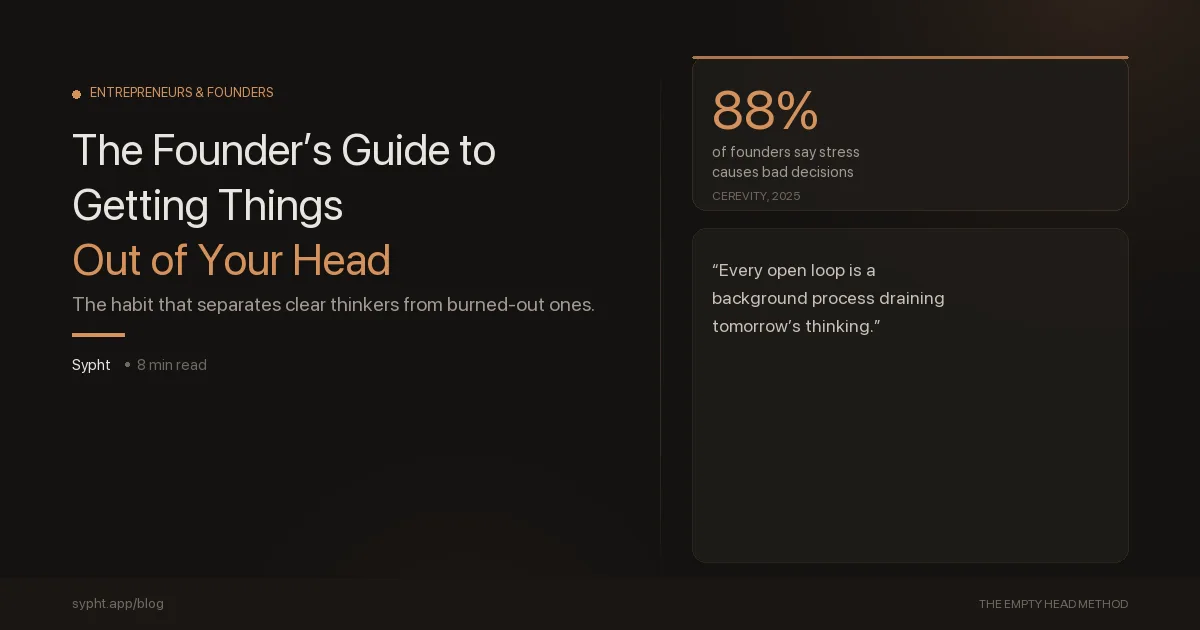
Every item you're holding in working memory, every open task, uncommitted decision, half-formed intention, thing you meant to follow up on, carries a continuous cognitive cost.
Psychologist Bluma Zeigarnik demonstrated in 1927 that unfinished tasks occupy privileged cognitive status: the brain treats them as active processes, surfacing them repeatedly, allocating monitoring resources to ensure they aren't forgotten. This evolved for good reason. In a simpler environment, this mechanism kept critical unfinished tasks from being dropped.
For a founder running a company, this mechanism runs continuously on dozens of items simultaneously. The result isn't just the subjective feeling of being overwhelmed, it's measurable impairment. Cognitive resources spent maintaining open loops are unavailable for the thing you're actually trying to do. The strategic thinking, the creative problem-solving, the quality attention that your work actually requires.
The invisible cost of carrying your business in your head is paid in the quality of every decision you make while carrying it.
What are the two ways founders fail at this?
Most founders fail at cognitive offloading in one of two ways.
The first is undercapture. They trust their memory for small things, only writing down the big ones. Small things accumulate silently. By Thursday the pile of small unmemoralised things that have evaporated is larger than they know.
The second is friction-blocked capture. They have a system, but the friction of using it is high enough that capture requires a deliberate stop. In the middle of a call, in the shower, mid-conversation with an investor, the moment passes before the capture happens, and the thought joins the pile of things trusted to memory.
Both failures have the same result: things that should be captured aren't. Open loops accumulate. The cognitive load grows. The quality of thought degrades.
What Low-Friction Capture Looks Like
The goal is to reduce the gap between "thought occurs" and "thought is captured" to as close to zero as possible, under any conditions.
Voice is the primary tool here. Saying something out loud is faster than typing it, requires no screen interaction, and can happen in nearly any physical situation, driving, walking, mid-task, pre-sleep. "Hey Siri, capture this in Sukima" and then a stream-of-consciousness offload of everything that's been accumulating since the last capture.
The critical constraint is that capture must not require organisation. The moment you have to decide what category something belongs to, which project it's part of, or how to tag it before it's in the system, friction is introduced. Some thoughts will be lost before the decision is made.
Capture first, organise later, ideally with AI handling the organisation automatically so the friction stays at zero.
What capture rhythm actually works?
Rather than trying to maintain a perfectly current system at all times, most high-functioning founders develop a rhythm of regular complete offloads.
Morning. Before opening email or jumping into reactive work: a 3-minute thought capture of everything that surfaced since yesterday. The things that occurred to you in the shower. The follow-up you meant to send last night. The idea that arrived at 2am. All of it, out.
After significant meetings or context switches. Every meeting surfaces new tasks, commitments, and information. Getting these out immediately, before the next context pulls them into the background, prevents the most common failure mode: the commitment made in a meeting that never becomes a task.
End of day. A closing offload of everything still outstanding. This isn't planning for tomorrow, it's permission for your brain to stop monitoring tonight. Research consistently shows that unresolved tasks at the end of the day impair evening recovery and sleep quality. A complete offload closes those loops.
Weekly. Once per week, a more thorough capture of everything that's accumulated that didn't make it into the regular rhythm. Longer-horizon items, strategic questions, things you're not sure how to categorise.
What to Do With the Pile Once It's Out
Getting things out of your head is step one. Step two is working through what you've captured in a way that doesn't recreate the overwhelm.
The mistake is reviewing everything at once and trying to prioritise across the full list. This is the approach most productivity systems encourage and most founders find paralyzing at scale.
A more effective approach: filter by current conditions. Right now, today, given my available time and energy, what's the single most appropriate next action?
This is context-aware rather than list-based. The question isn't "what's most important?", it's "I have an hour and high energy before this afternoon's calls: what should I do?" The answer is usually obvious once you've offloaded everything and can look at it clearly.
The Non-Negotiable: Trust
The entire system only works if you trust it completely.
If there's any doubt that something captured might be lost, your brain won't let it go. The loop stays open even after capture, because the system hasn't earned full trust. This is why partial systems fail, they capture some things reliably and lose others, and the brain learns it can't fully delegate.
A system you trust fully, one where you genuinely know that everything you've captured is there when you need it, is the only one that closes loops completely. Building that trust is the work of the first few weeks. Maintaining it is a commitment to using the system consistently, not just when it's convenient.
Once the trust is there, the relief is substantial and durable. Not the relief of having things done, the relief of knowing they're all held, and that you can think clearly about the work in front of you.
download it from the App Store
Sukima is on the App Store today. If your head is full and you're building something, this was built for you.
Sources:
Zeigarnik, B. On finished and unfinished tasks. Psychologische Forschung, 1927.
Allen, D. Getting Things Done. Penguin Books, 2001.
Risko, E.F. & Gilbert, S.J. Cognitive Offloading. Trends in Cognitive Sciences, 2016.