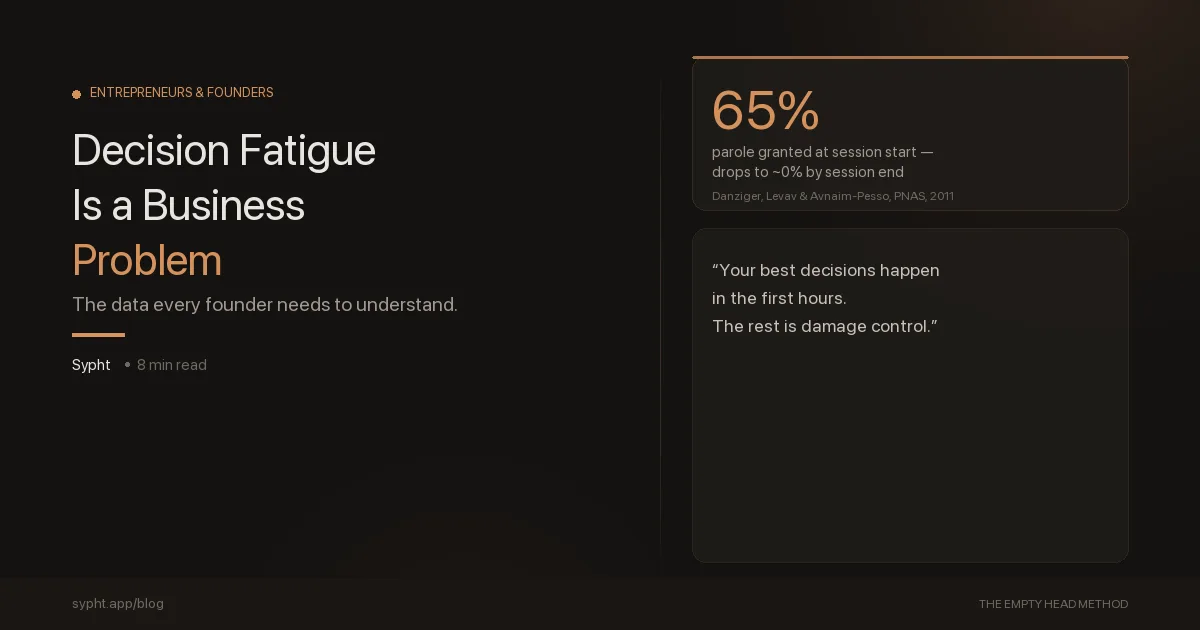
In 2011, researchers published a study that has since become one of the most cited examples in behavioural economics. They analysed over 1,000 parole board decisions by Israeli judges, looking for patterns in the rulings.
The pattern they found had nothing to do with the cases. It had to do with timing.
At the start of each session, judges granted parole at a rate of around 65%. As the session progressed, that rate declined steadily, dropping to near zero before each break, then resetting to 65% again after it. The quality, severity, and facts of the cases presented were irrelevant. What mattered was where the case fell in the decision sequence.
Judges who had made more decisions were worse at making decisions. Not worse by choice, not worse because they were tired in the ordinary sense, worse because the act of deciding depletes the cognitive resources required for deciding.
This is decision fatigue. And if you're a founder, it's costing you more than you know.
What is decision fatigue, actually?
The concept originates with Roy Baumeister's research on ego depletion, the finding that self-regulation, willpower, and effortful decision-making all draw on a common, limited cognitive resource. Like a muscle after sustained exertion, this resource depletes. After sufficient depletion, the quality of decisions degrades in predictable ways.
Depleted decision-makers tend toward three failure modes. They default to the status quo, choosing inaction over trade-off evaluation. They become impulsive, choosing the simplest or most immediate option without adequate consideration. Or they defer, avoiding the decision entirely and letting it accumulate in the unresolved pile.
For most knowledge workers, the number of significant daily decisions is moderate. They're making dozens of meaningful choices, not hundreds.
For founders, the number is categorically different. Every email requiring a response is a decision. Every hire, price, feature, partner conversation, team disagreement, and operational question is a decision. Context-switching between five different domains in a morning requires a fresh cognitive set for each switch, each of which has a depletion cost.
The research on founders is stark. A CEREVITY survey of tech founders found that 88% agree that excessive stress impairs their decision-making. Surveys consistently show that founders working without clear priorities experience substantially higher burnout rates, which is another way of saying that founders who face the most decision ambiguity, who have to decide not just how to do things but what to work on, are the most cognitively taxed.
How do founders encounter decision fatigue?
The depletion doesn't arrive all at once. It accumulates.
The first decision of the day, made with full cognitive resources, is the best one you'll make. The hundredth decision of the day, made after a morning of context-switching, an afternoon of meetings, and an inbox that required responses, is made with significantly degraded capacity.
The insidious part is that you often can't feel the difference. Decision fatigue doesn't feel like being tired in the ordinary sense. It feels like not caring as much about getting the answer right, or like the answer that was right ten minutes ago now seems obvious without renewed examination, or like a low-grade irritability that makes deliberation feel unnecessary.
The decisions that get made poorly late in the day are often not the trivial ones. They're the ones that require nuance, long-term thinking, or careful trade-off evaluation, exactly the kinds of decisions that determine the trajectory of a company. The quick reply that set the wrong precedent. The hiring decision made with insufficient deliberation. The strategic pivot agreed to at 6pm on a Friday that looked different on Monday morning.
The Cumulative Cost of What You're Holding
There's a second depletion mechanism that receives less attention: the ongoing cognitive cost of holding open decisions.
Every unresolved question, every "I need to think about that," every committed but unscheduled conversation, every task that hasn't been captured anywhere reliable, is an active cognitive process. It consumes working memory continuously, surfacing at intervals to make sure it isn't forgotten.
Founders tend to accumulate these at scale. The business is large enough that there are always more open questions than resolved ones. The pace is fast enough that new unresolved items appear faster than existing ones get closed.
The result is that the depletion doesn't start at zero each morning. It starts at whatever level the accumulated carry-forward has produced. For founders running under heavy cognitive load, this can be significant, the starting point for the day's decision-making is already partially depleted before a single decision has been made.
Externalising these open items, getting everything out of working memory and into a reliable external system, directly addresses this. The brain stops trying to hold them. The background load decreases. The starting point for the day's decisions is higher.
This is why the first action of the day matters: if you start by getting everything you're holding out of your head before engaging with the reactive demands of inbox and messages, you're making your first real decision from a less depleted state.
What do high-functioning founders do differently?
The pattern that emerges from studying effective founder productivity isn't a single system or methodology. It's a cluster of behaviours that, collectively, preserve decision quality:
Front-loading. Important decisions are made earlier in the day, before depletion compounds. Meetings requiring strategic decisions are scheduled in the morning. Reactive tasks (email, approvals, scheduling) are batched later.
Decision elimination. Anything that can be decided once and removed from future consideration is handled that way. Default rules, clear delegations, standing decisions. Every standing decision is one less depletion unit per day.
Capture discipline. Every open item, commitment, and task is externalised immediately rather than held in working memory. This reduces the carry-forward load that compounds morning depletion.
Constraint-based prioritisation. Rather than choosing from an open list each morning, the question becomes "given my energy right now and my schedule today, what's the one thing I should start with?" Constrained choice is easier than unconstrained choice, and the decision costs less cognitive fuel.
The Decision You Make Least Is the Most Valuable
There's an irony in all of this: the single most valuable decision a founder can make is to reduce the number of decisions they need to make.
This isn't abdication. It's resource management. A founder with preserved cognitive capacity makes better product decisions, better hiring decisions, better strategic decisions. A founder who has spent their best cognitive hours on a hundred small decisions makes worse ones.
Decision quality, not decision volume, is what matters. The research on decision fatigue makes the mechanism explicit: the resource is finite, the cost is real, and managing it deliberately is not a luxury but a prerequisite for the kind of thinking that actually builds companies.
download it from the App Store
Sukima is on the App Store today. For founders who need to protect the quality of what they think about.
Sources:
Danziger, S., Levav, J. & Avnaim-Pesso, L. Extraneous factors in judicial decisions. PNAS, 2011.
Baumeister, R.F. et al. Ego depletion: Is the active self a limited resource? Journal of Personality and Social Psychology, 1998.
Baumeister, R.F. et al. Self-control and limited willpower: Current status of ego depletion theory. ScienceDirect, 2024.
CEREVITY. Tech Founder Burnout Statistics 2025.