You're trying to watch a film and your brain is running through the list of things you haven't done.
You're in a conversation and a background process keeps surfacing: that email, the appointment, the thing you said you'd send by Friday.
You lie down to sleep and, somehow, this is when your brain decides to do a full inventory of every outstanding obligation since March.
For people with ADHD, this experience is near-universal. And it's more than just anxiety or overthinking, there's specific psychology behind it, and understanding it changes how you approach it.
What is the Zeigarnik effect?
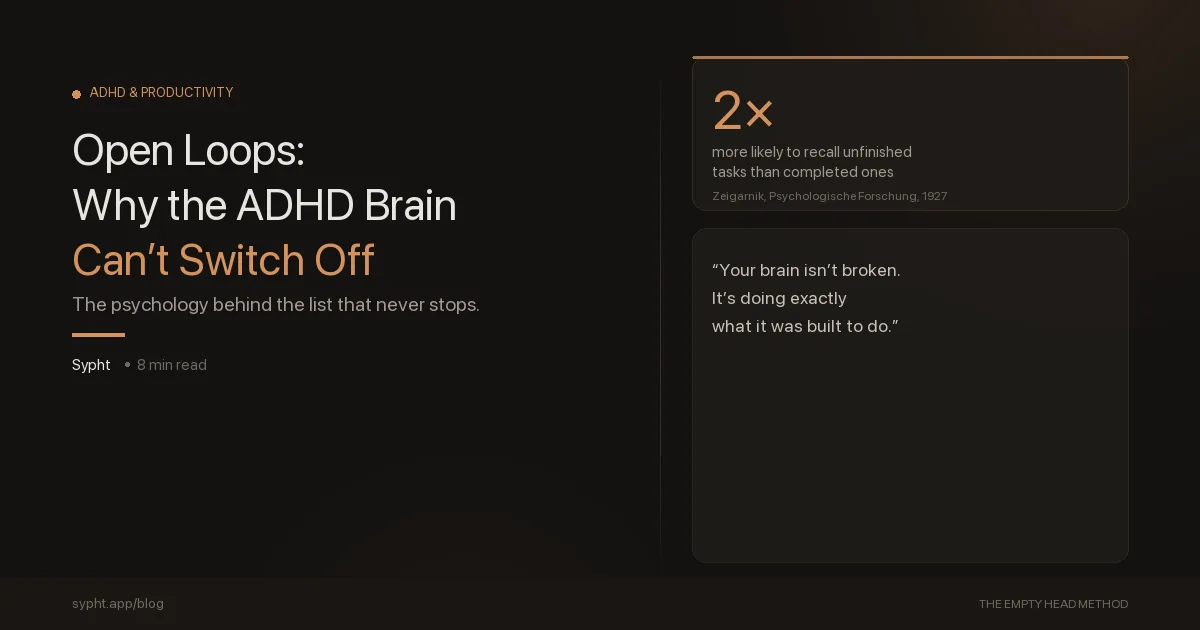
In 1927, a Lithuanian psychology student named Bluma Zeigarnik was having dinner with her supervisor at a Berlin café when he pointed out something curious: their waiter could recall every detail of unpaid orders at the table with perfect accuracy. But the moment the bill was settled, the details vanished. The waiter didn't know what table five had ordered five minutes ago.
Zeigarnik turned this observation into one of psychology's most enduring findings. Unfinished tasks, she discovered, occupy a privileged status in memory. The brain treats incomplete tasks as active processes, continuously allocating cognitive resources to them, keeping them accessible, surfacing them at intervals. The tension of incompletion drives the mind toward resolution.
This is the Zeigarnik Effect. Your brain doesn't just passively remember things you haven't done. It actively holds them open, treating them as ongoing business that requires attention.
In a brain with typical working memory function, this is manageable. The open loops are there, but they operate quietly in the background. In an ADHD brain, where working memory is demonstrably reduced and the filtering of irrelevant information is impaired, open loops are louder, more intrusive, and harder to manage.
The ADHD brain is running more processes with less RAM, and it can't close them down efficiently.
Why is closing loops harder with ADHD?
For most people, completing a task closes the loop cleanly. The tension releases, the mental file closes, the brain moves on. The waiter forgets the order.
For ADHD brains, the closure mechanism is less reliable. Tasks get partially done and half-filed. Intentions get formed but not followed through. Things get "mentally noted" rather than captured, and the mental note persists, open, active, consuming resources, without a clear way to close.
The result is a proliferating pile of open loops: things you've started but not finished, things you've thought about but not acted on, things you've meant to do but haven't yet captured anywhere reliable. Each one is a low-grade background process. Twenty of them create a constant cognitive hum that makes concentration feel impossible and genuine rest feel out of reach.
This is often misread as a focus problem. It's more precisely a closure problem. The brain isn't distracted by irrelevant things, it's being pulled by dozens of relevant things it's been instructed to remember.
The Research on Closing Loops Without Finishing Tasks
Here's the part that's particularly useful: you don't have to finish a task to close the mental loop around it.
Masicampo and Baumeister (2011) found that making a specific plan for an unfulfilled goal effectively eliminated the cognitive interference caused by that goal. It wasn't completion that closed the loop, it was having a concrete, trusted plan for completion. The brain, reassured that the task had a home and a next step, released its grip.
This is why writing things down works, even when you don't immediately do them. It's why David Allen's Getting Things Done advice to capture everything into a trusted system resonates with so many people, not because the system makes you more organised, but because it tells your brain "this is held, you can let go."
For ADHD brains, this principle is even more important, because the loops accumulate faster and are held more tenaciously. The relief of getting everything out of your head isn't just psychological comfort, it's measurable cognitive relief. Working memory freed from the burden of holding open loops has more capacity for the actual work.
Should you externalise everything, not just some things?
The trap most people fall into is partial externalisation. They put the big, urgent tasks into their system and try to hold the smaller, vaguer things in their head. The smaller, vaguer things are still open loops. They still consume resources.
An effective thought capture is complete: every task, worry, half-formed intention, thing you've been meaning to look into, conversation you owe someone, errand you keep forgetting, idea you want to revisit. All of it. Not the things that seem important enough to write down, everything.
This is harder than it sounds because ADHD brains are often not fully aware of how much they're carrying. The thought capture process itself is often surprising, you think you have ten things and discover you have forty.
But the relief that follows a genuine, complete thought capture is distinct and immediate. It's the sensation of closing dozens of loops simultaneously, the hum quiets, the RAM frees up, and actual rest becomes possible for the first time in days.
The Voice Capture Advantage
For ADHD brains specifically, voice capture has a significant advantage over writing when doing thought captures.
Writing is slow relative to thought speed. By the time you've written one item, the next thought has often displaced the previous one, or you've started evaluating what you're writing rather than continuing to capture. The linear, slow pace of writing creates friction with the rapid, associative nature of ADHD thinking.
Voice is faster, lower-friction, and more naturally parallel with how ADHD brains actually surface information: in bursts, associatively, not in neat sequential order. "I need to do X, also Y, wait and there's Z, oh and I keep forgetting W", that stream, captured in voice, becomes four captured tasks without any of the friction of writing them individually.
Sukima is built on this insight. You speak freely, in whatever order things surface, and the AI handles the work of parsing, categorising, and prioritising everything you said. The goal is the most natural possible externalization, closest to the brain-to-trusted-system transfer that actually closes loops.
Does rest become possible when loops are closed?
One of the most disruptive symptoms of ADHD-driven open loops is the impact on sleep and recovery. Research by Weigelt and Syrek found that unfinished tasks at the end of the week significantly impaired weekend recovery through rumination, the loops staying active during what should be rest time.
For ADHD adults who already struggle with sleep and downtime, this is compounding. The loops that keep surfacing during the day don't turn off at night. They show up in the period before sleep, precisely when the brain is supposed to be winding down.
A brief thought capture at the end of the working day or before bed doesn't solve ADHD. But it does something specific and useful: it tells the brain that everything is held, everything has a home, and there's nothing left to track. The loops close. The hum quiets. Sleep becomes easier.
Not every time. But reliably enough to be worth the three minutes it takes.
download it from the App Store
Sukima is on the App Store today. If your brain runs the list when it should be resting, it was built for exactly this.
Sources:
Zeigarnik, B. On finished and unfinished tasks. Psychologische Forschung, 1927.
Masicampo, E.J. & Baumeister, R.F. Consider it done! Plan making can eliminate the cognitive effects of unfulfilled goals. Journal of Personality and Social Psychology, 2011.
Weigelt, O. & Syrek, C.J. Unfinished tasks and recovery. Journal of Occupational Health Psychology, 2017.
Cortese et al. Cognitive Impairment in Adult ADHD. PMC, 2025.